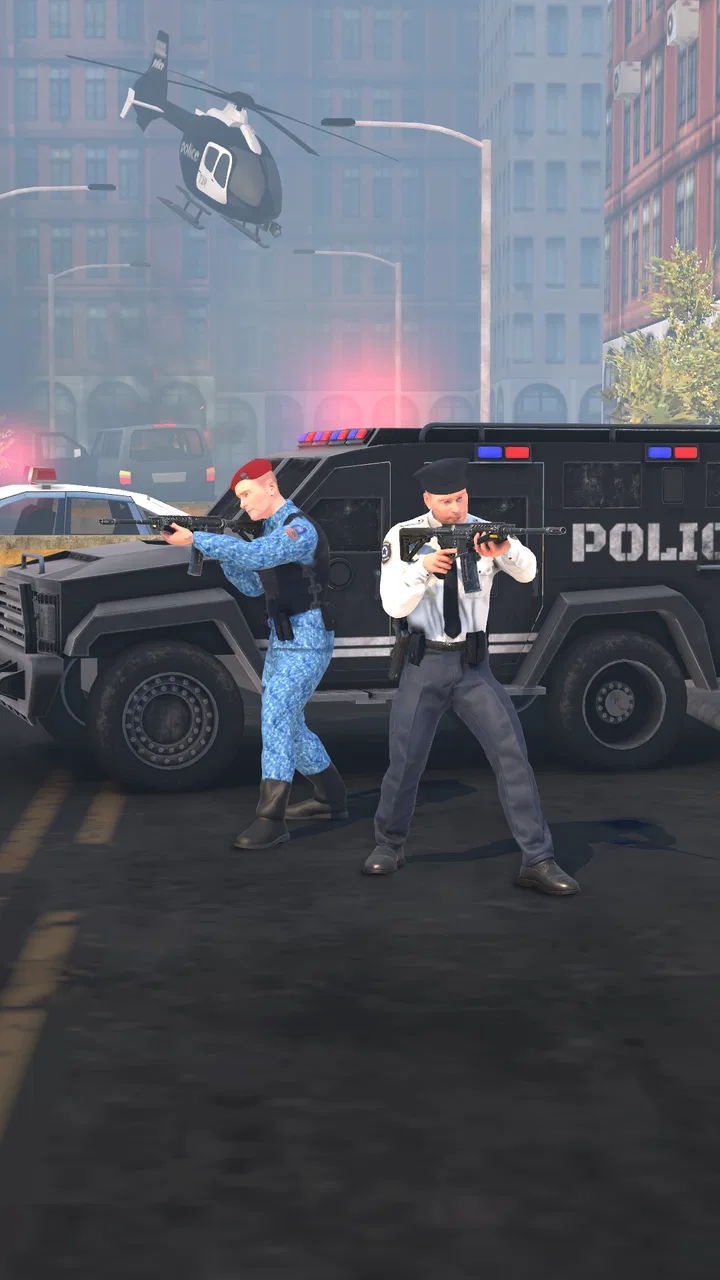
Rescue Cop: Shooting Game
- 4.4
- Rating
- 10.00M
- Installs
- Free
- Price

 Analysis by App-foxy
I first approached Rescue Cop: Shooting Game expecting a quick action title built around short bursts of police-themed shooting. That expectation is important, because this is not presented as a slow, investigative police drama or a large tactical simulation. It is a focused action game from Homa that puts precision shooting and hostage rescue at the center of the experience. After spending time with it, I found its strongest quality to be its clarity: the game quickly tells me what kind of player it wants, what kind of attention it rewards, and when its compact structure may start to feel repetitive.
The basic fantasy is easy to understand. I take the role of a rescue officer, line up shots, deal with threats, and try to protect the hostages caught in the situation. That simple setup gives every encounter an immediate purpose. I am not firing merely to clear a screen; I am expected to control the situation carefully enough to avoid turning a rescue into a reckless firefight. Even when the action remains accessible, that objective gives the shooting a little more tension than a standard target practice game.
The game is free to start, which makes it straightforward to try without committing money first. It is rated Teen, so I would place it closer to light action with a more serious rescue theme than to a family-oriented casual game. Its Android listing shows an average of 4.4 from around 154 thousand ratings, with more than 10 million installs. Those figures suggest that the short-session format has reached a broad audience, but they do not change the practical question: whether its particular mix of aiming, police imagery, and repeated rescue scenarios fits the way you like to play.
You May Also Like

 Blood Strike: 2.5 Anniversary
Blood Strike’s Loadouts Turn Every Drop Into a Tactical Gamble
A close look at Blood Strike’s custom loadouts: how fast access to signature weapons reshapes its battle royale rhythm, rewards preparation, and narrows the gap between fights.

 Pandora - Music & Podcasts
Pandora’s Music Is Easy to Start, but Harder to Recover
Pandora’s strength is its low-effort path from a seed to a station. Its weak spot is how much confidence it asks you to place in connection, setup, and quiet recovery.

 8 Ball Pool
 Is Built on Rivalries, Rematches, and Routine
A close look at the rivalries, rematches, shared routines, and unanswered safety questions that turn a quick pool match into a persistent mobile community.

 Samsung Music
’s Quiet Strength Is Playing What You Already Own
Its reach comes less from spectacle than from dependable access to a personal library. That simplicity is both the app’s strongest retention engine and its ceiling.

 AccuWeather: Weather Radar
AccuWeather Review: A Quick, Clear Forecast for Everyday Decisions
For everyday plans, the best forecast is the one you can understand quickly. AccuWeather makes rain timing, radar, and local conditions easy to act on, with a few trade-offs.

 Hill Climb Racing
Why Hill Climb Racing Still Turns Crashes Into One More Run
A tiny car, a bumpy hill and one more upgrade: Hill Climb Racing keeps resurfacing because its simple chaos makes every near-miss feel personal.
More From Our News Desk



How Rescue Cop builds its playable mood
I find the game’s mood works best when I treat each scene as a small problem to read, rather than a row of targets to clear. That approach makes the rescue premise feel more purposeful and gives the action a measured tension, even in a brief session. It also helps explain why the game suits focused bursts better than a long, uninterrupted playthrough.
A direct first impression that gets to the point
The opening impression is deliberately immediate. The game does not need a long explanation to communicate its role because the central action is familiar: identify the danger, aim with care, and rescue people under pressure. I appreciate that directness on a phone. When I have only a few minutes, I do not want to navigate layers of setup before reaching the part that makes the game distinctive.
That simplicity also creates the first important trade-off. Players who enjoy large maps, deep equipment management, complex police procedures, or a detailed campaign structure may find the experience too narrow. The appeal is not in simulating every part of law enforcement. It is in turning a rescue scenario into a sequence of readable shooting decisions. I would recommend it to someone who wants a compact action game with a clear objective, not to someone searching for a full-scale tactical simulator.
My most useful early habit was to stop treating every visible target as an invitation to shoot immediately. The rescue framing makes precision more valuable than speed. I found it better to scan the scene, identify the immediate threat, and consider where a shot could go before acting. That approach is more satisfying than simply tapping as quickly as possible, and it helps preserve the feeling that I am solving a dangerous situation rather than playing a reaction test.
This is also a good game to use in small gaps during the day. A short break between errands, a commute with a few spare minutes, or a quick session before putting the phone away all suit its straightforward premise. I would not choose it when I want a long evening of character development or exploration. Its strength is that it can establish a goal quickly and let me act on it without demanding a large time investment.
Visual language: police drama reduced to readable action
The setting works because it communicates urgency without requiring a large amount of explanation. Police imagery, threatened civilians, and the act of carefully clearing danger all point in the same emotional direction. The world is not trying to be a detailed open city with a broad social simulation. Instead, it functions like a series of compact stages in which the visual arrangement supports the immediate question: what must I protect, and what must I neutralize first?
I found that this visual focus helps the controls feel purposeful. Hostages are not just background decoration; their presence changes how I read the scene. A careless shot feels wrong because it conflicts with the rescue objective, even if the game presents the action in an accessible way. That connection between setting and mechanic is one of the better choices here. The police theme is not merely pasted onto a generic shooting format; it gives the player a reason to value control.
The art direction is most effective when it keeps the action legible. In a mobile shooter, visual clutter can make aiming feel unfair, especially when the screen is small or I am playing quickly. Rescue Cop benefits from a presentation that appears designed around recognition rather than realism. I can understand the basic roles in the scene without needing to study a complicated interface or memorize a large set of visual symbols.
That readable approach has a limit. Players who want a gritty, highly realistic police atmosphere may find the presentation lighter and more game-like than expected. The setting establishes a mood of urgent rescue, but it does not replace the depth of a narrative crime game. I think that is a sensible choice for this format, although it means the emotional impact depends heavily on how much interest I bring to the scenario myself.
One practical tip is to play with the phone held steadily rather than trying to use the game while walking or multitasking. The visual language asks me to notice small relationships between threats and hostages, and that is easier when the screen is not moving. I also found that lowering my speed improved my accuracy more than trying to develop frantic reflexes. The game’s police identity is strongest when I play like someone managing risk, not like someone chasing a high-speed arcade score.
Sound and rhythm: pressure without overwhelming the player
Sound has an important job in a game built around short encounters. It needs to make each shot feel consequential, support the rescue atmosphere, and keep the pace from becoming flat. In my experience, the audio works best as a layer of pressure behind the visual decisions. It reinforces the sense that an encounter is active and dangerous, while the player still has to do the important work of aiming and choosing the right moment.
The rhythm is more significant than any single sound effect. A good rescue sequence needs a pattern of observation, action, and brief relief. If everything happens at maximum speed, precision becomes less meaningful. If the game pauses too often, the police scenario loses urgency. Rescue Cop sits closer to the accessible, brisk side of that balance. I can understand the objective quickly, make a shot, and move toward the next decision without waiting through a long cinematic transition.
That pacing makes the game easy to fit into ordinary routines, but it also explains why some players may want more variation. Short action loops are satisfying when I am in the mood for a concentrated challenge. Over a longer session, the same structure can begin to reveal its limits. I would play it in focused bursts rather than expecting it to sustain a multi-hour marathon with constant novelty.
My advice is to pay attention to the change in rhythm between looking and firing. The most enjoyable moments are not necessarily the fastest ones. They come when I recognize that a calm pause can be more useful than an immediate shot. That small adjustment turns the game from simple tapping into a modest exercise in timing. It is not deep tactical planning, but it is enough to give the action a recognizable pulse.
Where the mechanics fit—and where they do not
The central mechanics suit the mobile format because they are easy to understand and difficult to perform carelessly. Shooting with precision sounds simple, yet the hostage-rescue context gives that action a constraint. I have to balance speed against control. That is the main mechanical idea, and it is the reason the game feels more purposeful than a target gallery with a police skin.
I especially like the way the objective gives me a reason to look beyond the nearest opponent. In many action games, the most obvious threat automatically becomes the only thing that matters. Here, the presence of hostages changes the order in which I think. I need to read the whole situation, not just react to the first target I notice. That is one of the game’s less obvious strengths and a useful mindset for anyone who initially finds the shooting too basic.
For a better session, I would use three simple habits. First, identify the hostage position before committing to a shot. Second, favor deliberate aim over repeated rapid taps when the scene feels crowded. Third, treat a failed attempt as information about timing and positioning rather than immediately changing everything. These habits do not turn the game into a hardcore tactical experience, but they make the existing mechanics feel more deliberate.
The controls and structure are also approachable for players who do not normally play shooters on a phone. Someone looking for a gentle introduction to aiming-based action may find the police-rescue framing less intimidating than a competitive multiplayer shooter. There is no need to understand a large weapon ecosystem or a complicated team role before getting started. That accessibility is a real advantage for casual players.
On the other hand, experienced shooter fans may want more mechanical depth than the core loop provides. If your favorite part of the genre is extensive loadout planning, advanced movement, competitive matchmaking, or large-scale level navigation, this is probably not the best destination. A conventional tactical shooter or a story-driven action game would offer more room for long-term mastery in those areas. Rescue Cop is better understood as a focused, self-contained action experience.
The free entry point is helpful, but the presence of optional purchases is worth keeping in mind. Items are listed at prices ranging from $2.99 to $14.99 each. I would approach those purchases cautiously and first decide whether the basic rescue loop is enjoyable on its own. For me, the game needs to earn continued attention through its moment-to-moment precision rather than through pressure to buy something. Players who dislike in-app purchase prompts should be prepared for that aspect of the mobile format.
The current Android version is 6.1.0, and the listed minimum operating system is Android 7.1. That makes compatibility fairly broad for many Android users, though I would still check the device requirements before installing on an older phone. The game is also available as a mobile action title rather than a demanding console-style production, so its best use is as a convenient pick-up-and-play experience rather than a replacement for a larger platform shooter.
Who will enjoy the rescue-focused format?
I think this game is a good match for people who like action with an obvious objective. If you enjoy the feeling of lining up a shot, making a quick decision, and seeing that decision immediately affect a rescue scene, the design has a clear appeal. It is also suitable for players who prefer sessions that begin quickly and do not require a large amount of story knowledge or preparation.
It may work especially well for someone who usually finds shooters too chaotic. The hostage objective encourages a slower first look and gives accuracy a practical purpose. A player can build confidence by learning to read the scene before trying to act faster. That makes the game a useful stepping stone into mobile action, even though it will not satisfy someone seeking a complex simulation.
I would skip it if you need a strong narrative reason to keep playing, a broad sense of exploration, or a highly competitive environment. The police setting gives the encounters identity, but it is not the same as a character-driven campaign. I would also look elsewhere if repeated rescue-and-shooting scenarios quickly lose their appeal for you. The game’s focused design is its advantage in short sessions and its main limitation over extended play.
One realistic use case is a player who has ten minutes after work and wants something more engaging than a passive scrolling session. I could open the game, play a few focused encounters, and put it down without needing to remember a complicated plot or manage a long-term build. By contrast, on a quiet weekend when I want to become absorbed in a world, I would choose a larger action game with exploration and progression that can support a longer sitting.
My atmosphere verdict after balancing style and action
Rescue Cop succeeds when its presentation and mechanics point toward the same feeling: controlled urgency. The police-rescue setting gives the shooting a clear emotional frame, the visual language keeps the situation understandable, and the rhythm supports quick decisions without demanding the complexity of a full tactical simulator. I found the result easy to pick up and more thoughtful than its simple premise might suggest.
Its limitations are equally clear. The compact action loop may not provide enough variety for players who expect a deep campaign, and the mobile purchase structure may bother anyone who wants a completely uninterrupted experience. The game also asks me to supply some of the emotional investment myself; its atmosphere is coherent, but it is built to support action rather than deliver a heavily developed police story.
Still, I would recommend giving it a try if you want a free action game that combines accessible shooting with the extra responsibility of protecting hostages. Homa has kept the focus narrow enough for mobile play, while the rescue objective gives each encounter a useful layer of judgment. My strongest recommendation is to approach it patiently: look first, aim carefully, and let the setting’s tension come from making the right shot rather than the fastest one.
In the end, Rescue Cop: Shooting Game is most convincing as a concise mood-driven shooter. It does not need to imitate a large console police game to be enjoyable. Its identity comes from the meeting point between readable scenes, brisk pacing, and precision under pressure. If that combination sounds appealing, the free download makes trying it an easy decision; if you want expansive systems or a richer story, you will probably be happier with a more ambitious alternative.
FAQs for Rescue Cop: Shooting Game
01What is Rescue Cop: Shooting Game about?
Rescue Cop: Shooting Game is an action-packed mobile game where you play as a police officer tasked with rescuing hostages and taking down criminals. The game combines shooting mechanics with strategic planning, offering various missions and levels to challenge your skills. Players must navigate through different environments, ensuring the safety of civilians while neutralizing threats.
02What devices is Rescue Cop: Shooting Game compatible with?
Rescue Cop: Shooting Game is available for both Android and iOS devices. It supports a wide range of smartphones and tablets, ensuring smooth gameplay across different screen sizes. Make sure your device meets the minimum operating system requirements, such as Android 6.0 or iOS 11, to enjoy the best gaming experience.
03Are there in-app purchases in Rescue Cop: Shooting Game?
Yes, Rescue Cop: Shooting Game includes in-app purchases. Players can buy various items, such as weapons, outfits, and power-ups, to enhance their gameplay experience. While the game is free to download and play, these optional purchases can help you advance more quickly in the game. Always check the price before confirming any purchase.
04Does the game require an internet connection to play?
Rescue Cop: Shooting Game can be played both online and offline. However, certain features, like leaderboards and daily challenges, require an internet connection. Playing offline allows you to progress through missions, but connecting to the internet ensures you can fully enjoy all aspects of the game, including updates and rewards.
05How does the game ensure player safety and privacy?
Rescue Cop: Shooting Game is committed to player safety and privacy. It adheres to strict privacy policies to protect user data. The game requires minimal permissions on your device and does not share personal information with third parties. Parents can also set up controls to manage in-app purchases and screen time for younger players.
Pros
- Engaging gameplay with varied missions.
- Intuitive controls for smooth navigation.
- Stunning graphics enhance visual appeal.
- Regular updates with new content.
- Offline mode available for uninterrupted play.
Cons
- Occasional in-game ads disrupt flow.
- Limited customization options for characters.
- Difficulty spikes can be frustrating.
- High battery consumption during play.
- In-app purchases for essential items.

Rescue Cop: Shooting Game
Gallery